


Every week: one number, three stories, and why they matter for the value of your data.
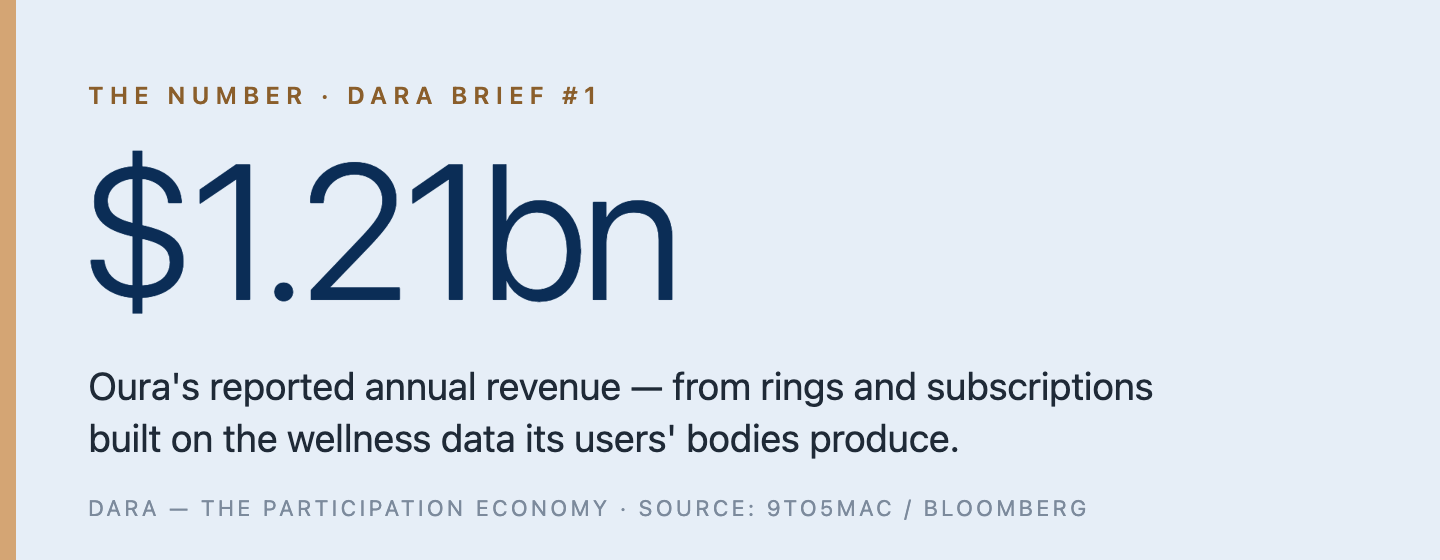
The number: $1.21 billion
That is Oura’s revenue for the nine months to June 2026, according to recent disclosures — built on 3.6 million rings a year and a subscription that interprets what its users’ bodies produce every night. Wellness data is no longer a side feature. It is a business model.
1. The EU makes device data yours — by design
Since 12 September, the EU Data Act’s “access by design” rule applies to new connected products and services sold in Europe. Data a device generates must now be directly and automatically available to the user — no requests, no extra steps.
Why it matters: For wearables and health apps, this moves control of the data stream a step closer to the person producing it. But access is not the same as sharing in the value. The Data Act gives you the key to the room — not a share of what is earned inside it.
2. Apple wants to compete for your body data
Apple is developing a screenless, Whoop-style fitness band, Bloomberg reports. The project is still at an early stage, with no launch expected before 2028.
Why it matters: The largest consumer tech company in the world is moving further up the data hierarchy — from what you tap on a screen to what your body does around the clock. When the biggest platforms race for continuous wellness data, the question of who benefits from it gets more urgent, not less.
3. “Anonymised” health data is still leaking
New US state privacy laws restrict the sale of health app data, but a de-identification loophole remains: fitness and nutrition data stripped of names can still reach data brokers, Consumer Tech Wire reports. Privacy experts warn that a daily stream of meals, weight and location-tagged workouts is often re-identifiable.
Why it matters: If “anonymous” wellness data still has market value, it is being monetised — without the people who produced it seeing any of that value.
The DARA take
Rights to access our data are arriving. Rights to its value are not. That gap — between controlling your data and participating in what it earns — is where the participation economy will be decided. We will keep tracking it.
Sources: DIHK – Data Act from 12 Sept 2026 · Wilson Sonsini – EU Data Act deadline · 9to5Mac / Bloomberg – Apple screenless tracker · Consumer Tech Wire – health app data-broker gap
Browse every source we cite in the DARA Source Library. Work in this field and have a tip or a topic? Send us a message on Substack or reply to this email.
Thanks for reading DARA — The Participation Economy. Subscribe for free to receive new posts and support our work.