

Data created extraordinary wealth. The people who generated most of it received almost none of it. This is not primarily a moral observation — it is a description of a structural feature of the data economy as it has operated until now. And the structure is beginning to crack.
Where the money went
Thanks for reading DARA — The Participation Economy. Subscribe for free to receive new posts and support our work.
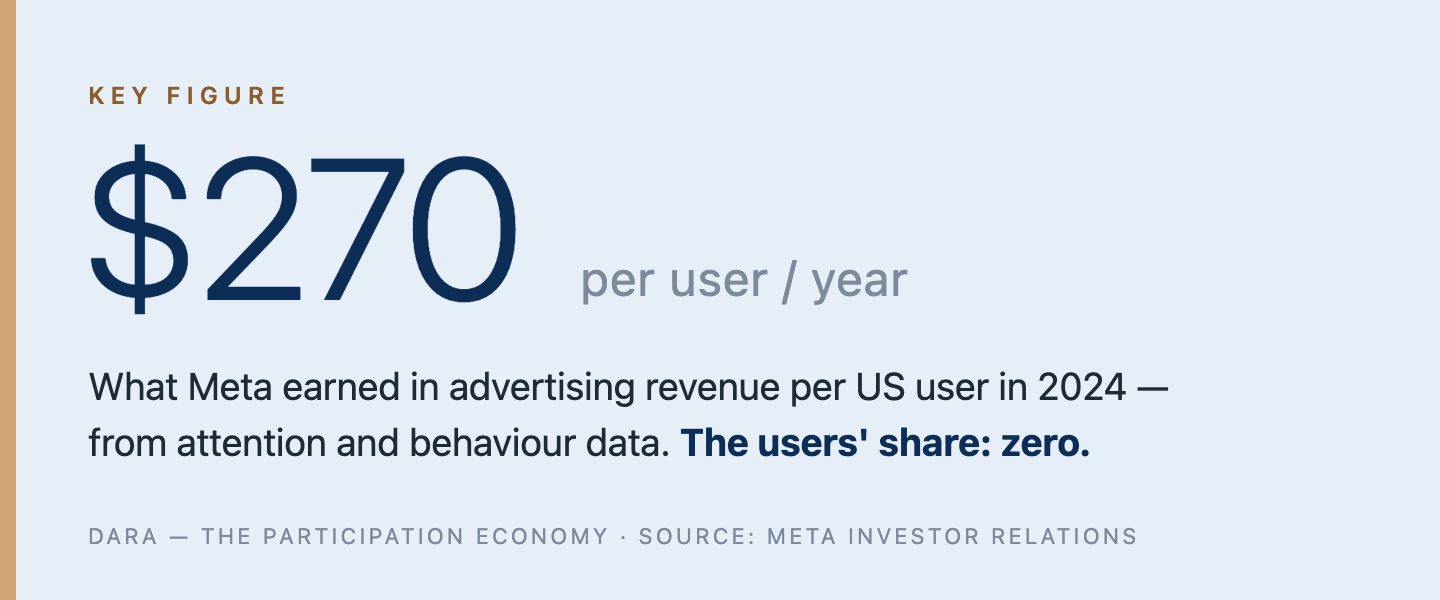
In 2024, Meta generated $270 in advertising revenue for every user in the United States. Not from selling products. Not from charging subscription fees. From selling access to the attention and behavioural profiles of its users to advertisers. The users themselves received nothing.
This was not unique to Meta. It was the operating model of the entire digital economy. Google, TikTok, X, and hundreds of smaller platforms were built on the same foundation: collect data about people, use it to build profiles, and sell those profiles to advertisers. The more data, the better the profiles. The better the profiles, the higher the price.
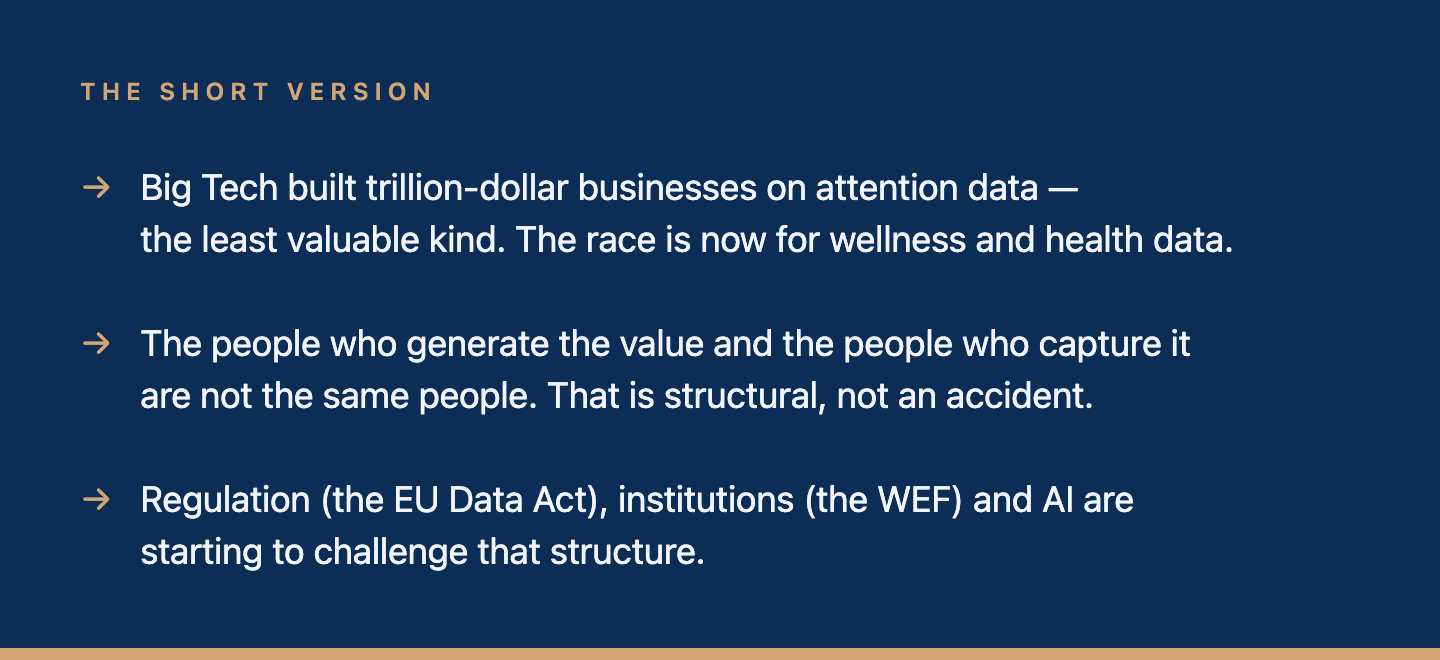
The result was one of the most concentrated transfers of economic value in modern history. Digital platforms now represent $24 trillion of the global economy — 21 percent of world GDP, according to the Platform Executive’s 2026 State of the Platform Economy report. That wealth was built primarily on data that people generated without compensation, often without a clear understanding of how it was being used.
What the data actually was
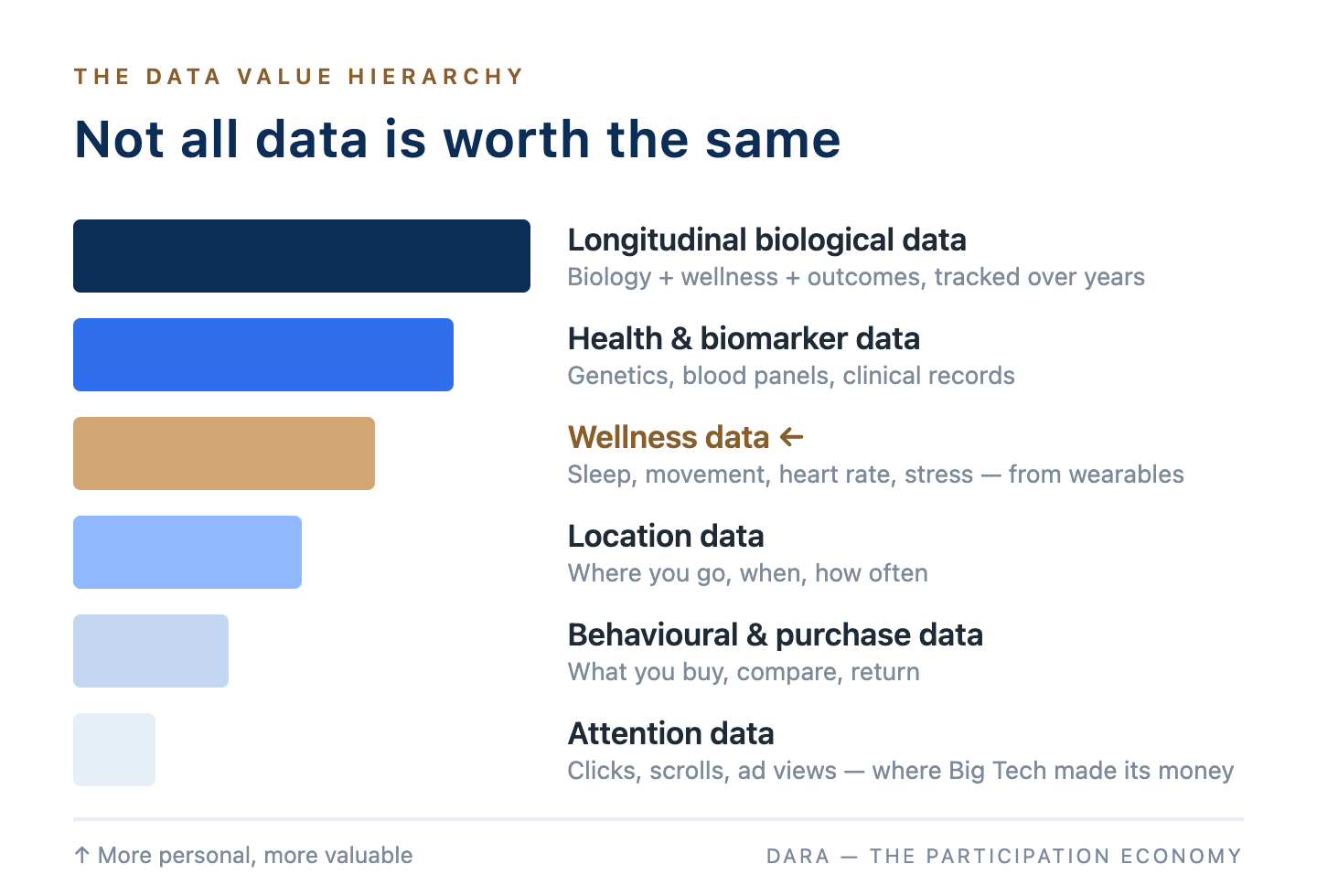
To understand why this happened, it helps to understand what “data” actually means in this context — because not all data is worth the same.
At the bottom of the value hierarchy sits attention data: the fact that you looked at something, clicked on it, scrolled past it. This is the oldest and cheapest form of digital value. Advertising platforms have traded in it since the early days of the internet.
Above that sits behavioural and purchase data: what you buy, when you buy it, what you search for before and after, how your spending patterns shift over time. This is worth considerably more, because it predicts future behaviour with much greater accuracy.
Then comes location data: where you go, how often, at what times, with whom. A phone that knows your daily movements knows more about your life than most people do.
Above that sits wellness data — the layer that is now becoming economically significant. Sleep patterns, movement, heart rate, nutrition, stress indicators, recovery. This data comes from wearables, health apps, and connected devices. It is continuous, personal, and detailed in ways that older forms of data were not. It sits between everyday behaviour and clinical health information, and it is the category that technology companies are now competing most aggressively to collect.
At the top of the hierarchy sits health and biomarker data: clinical records, genetic information, longitudinal biological measurements taken across years or decades. This is the most valuable category of personal data in existence. A dataset combining genetic profiles, health records, and continuous wellness tracking from a large population is worth billions — not because it can be sold to advertisers, but because it can be used to develop drugs, design interventions, and build AI systems that transform how medicine works.
Why the structure is cracking
For twenty years, the legal and regulatory environment allowed this system to operate largely unchallenged. That is changing.
The European Union’s Data Act came into full effect in September 2026. Among its provisions: every connected device sold in the EU must now make the data it generates accessible to the user who generated it — in real time, in machine-readable formats, free of charge. The maximum fine for non-compliance is €15 million. This is not a minor regulatory adjustment. It is a legal reframing of who owns device-generated data.
The World Economic Forum published a report in September 2026 calling explicitly for a rebalancing of the health data economy. Its argument was straightforward: patients and health systems bear most of the costs of generating health data, while the financial gains flow elsewhere. The WEF called this a structural problem requiring structural solutions.
At the same time, AI is creating new forms of economic participation that did not exist before. According to Menlo Ventures’ 2026 State of Consumer AI report, consumer spending on AI tools reached $40 billion in 2026 — up from $12 billion the previous year. Nearly half of active AI users are now earning income through AI in some form. The question of who gets paid, for what, and on what terms is becoming one of the defining economic questions of this decade.
The question this publication exists to ask
None of this resolves the underlying problem automatically. A legal right to access your data is not the same as participating economically in its value. A report calling for rebalancing is not the same as rebalancing.
But the conditions for something different are beginning to exist. The regulatory framework is shifting. The technology is changing what kinds of data can be collected, and what it is worth. And the question of economic participation — who benefits when a system learns from the activity of thousands or millions of people — is moving from the margins to the centre of the debate.
Whether that changes, how it changes, and who shapes the change — that is what DARA exists to track.
Sources: Platform Executive (2026) · Meta Investor Relations · Faegre Drinker / EU Data Act · World Economic Forum · Menlo Ventures
Browse every source we cite in the DARA Source Library.
Thanks for reading DARA — The Participation Economy. Subscribe for free to receive new posts and support our work.